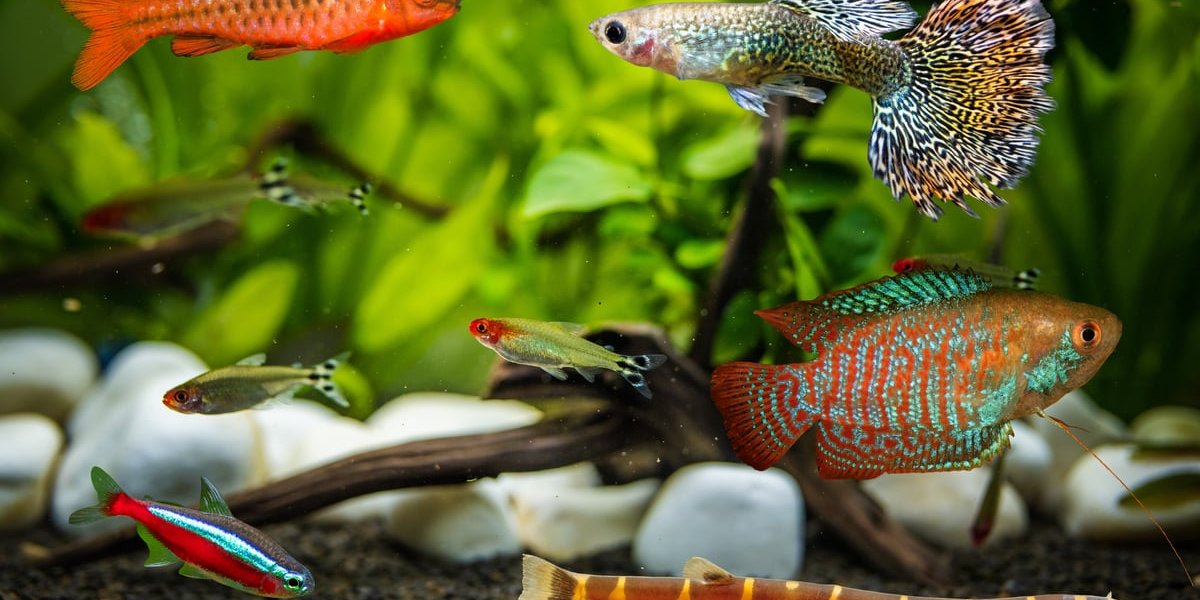
A peaceful community tank is one of the most beautiful and enjoyable setups in the freshwater hobby. Watching a mix of colorful, harmonious species swim together through plants and driftwood is genuinely relaxing, and it is more achievable than many beginners expect. The key is choosing fish that share compatible temperaments, water requirements, and size.
The fish on this list are chosen not just for their peaceful nature, but for their availability, hardiness, and the visual diversity they bring to a community tank. Most are widely sold at pet stores and adapt well to typical community water conditions of 72 to 78°F with a neutral to slightly acidic pH.
1 / 10Neon Tetra (Paracheirodon innesi)
The neon tetra is perhaps the most iconic community fish in the world, and its popularity is fully deserved. These small schooling fish reach about 1.5 inches and display a brilliant electric blue stripe with a vivid red tail that catches the eye even in a busy tank. They are completely peaceful toward all similarly sized fish and pose no threat to anything they share the water with.
Neon tetras must be kept in groups of at least six, and they look most natural and behave most confidently in groups of ten or more. They prefer soft, slightly acidic water and subdued lighting, which suits a planted aquarium perfectly. They are a foundational fish for any community setup and mix well with virtually every other species on this list.
2 / 10Harlequin Rasbora (Trigonostigma heteromorpha)
The harlequin rasbora is a stunning mid-water schooling fish with a distinctive black triangular patch on its rear half and a copper-orange body. It reaches about 1.75 inches and is one of the hardiest and most adaptable rasboras available. Unlike some schooling fish that dart erratically, harlequin rasboras swim together in tight, graceful formations that are mesmerizing to watch.
They thrive in the same water conditions as neon tetras, making them natural tank mates. Groups of six to ten fish are recommended, and they coexist peacefully with all non-aggressive species. They also tend to be less susceptible to neon tetra disease, which makes them a slightly more reliable choice for beginners concerned about health issues.
3 / 10Corydoras Catfish (Corydoras spp.)
Corydoras catfish are the quintessential peaceful bottom dwellers. These small, armored catfish reach 1 to 3 inches depending on species and spend their time rooting through the substrate searching for food scraps. They are completely harmless to all other fish and actually help keep the tank clean by consuming leftover food before it decays.
Popular species include Corydoras paleatus (peppered cory), C. sterbai, and C. trilineatus. All corydoras are social fish that must be kept in groups of at least four to six of the same species. They prefer fine, smooth substrate rather than sharp gravel that can damage their sensitive barbels. They breathe air periodically by darting to the surface, which is normal behavior and not a sign of distress.
4 / 10Otocinclus Catfish (Otocinclus spp.)
The otocinclus, often called oto catfish, is a tiny algae-eating catfish that reaches only about 1.5 inches. They are the gold standard for algae control in planted community tanks, grazing continuously on soft green algae that coats leaves and glass without harming plants or bothering other fish. They are completely inoffensive and spend their entire lives eating algae and resting on flat surfaces.
Otos are social and should be kept in groups of four or more. They can be delicate when first introduced, so a well-established, cycled tank is important. Once settled, they are hardy and long-lived. They complement neon tetras, rasboras, and most small community fish perfectly, occupying the glass and lower areas of the tank without competing for the same space.
5 / 10Dwarf Gourami (Trichogaster lalius)
The dwarf gourami brings bold color and personality to a community tank without the aggression of larger gourami species. Males display vibrant red and blue stripes and grow to about 2 inches, while females are more subdued in silver-gray. They are labyrinth fish that breathe air at the surface, making them particularly interesting to observe as they periodically visit the top of the tank.
Male dwarf gouramis can occasionally be territorial with each other, so keeping one male per tank or one male with two females is recommended. They are peaceful toward all other community fish and add a different body shape and swimming level (mid to upper water) that enhances the variety of a mixed tank. Avoid housing them with nippy fish like tiger barbs that may damage their flowing fins.
6 / 10Cherry Barb (Puntius titteya)
The cherry barb is a peaceful barb that defies the reputation of its more aggressive relatives like the tiger barb. Males develop a striking deep red coloration when in breeding condition, and even females show a pleasant rosy hue. They reach about 2 inches and are active, curious fish that add lively movement to mid-water levels of the tank.
Unlike tiger or rosy barbs, cherry barbs do not fin-nip and are safe with fish that have flowing fins. They do well in groups of six or more, with a mix of males and females producing the best coloration as males compete to impress females. They are easy to feed and accept flake food readily, making them one of the most beginner-friendly barbs available.
7 / 10Zebra Danio (Danio rerio)
The zebra danio is one of the hardiest freshwater fish available, tolerating a wide range of temperatures and water conditions that would stress more sensitive species. They reach about 2 inches and are constantly active, darting around the upper portions of the tank with energetic, playful behavior. Their horizontal blue and silver stripes make them easy to spot in a busy aquarium.
Zebra danios are completely peaceful toward other fish and are particularly useful in new tanks because they can handle the cycling period and the subsequent parameter fluctuations better than most. They need to be kept in groups of at least five to six to express their schooling behavior. Their active nature livens up any community tank and encourages shyer species to come out from hiding.
8 / 10Platy (Xiphophorus maculatus)
Platys are hardy, colorful livebearers that come in an enormous variety of color forms, from red and orange to blue, black, and multicolored combinations. They reach 2 to 2.5 inches and are extremely easy to keep, tolerating a range of water hardness and temperature that few other fish can match. They eat virtually anything offered to them and are exceptionally disease-resistant.
Platys are peaceful toward all other community fish, though males may occasionally chase females. Keeping one male per two to three females reduces stress on the females. Be aware that platys breed readily in a community tank, and fry will be eaten by other fish unless actively protected. If you do not want an explosion of fish, keep only one sex or plan to rehome fry regularly.
9 / 10Bristlenose Pleco (Ancistrus spp.)
The bristlenose pleco is the community tank algae-eater of choice for larger setups. Unlike common plecos that outgrow most home aquariums and can reach 18 inches, bristlenose plecos stay at 4 to 5 inches and remain manageable throughout their long lives. They are completely peaceful, spending most of their time grazing on algae from wood, rocks, and glass.
Bristlenose plecos benefit from having driftwood in the tank, as they rasp on wood to aid digestion. Supplement their diet with algae wafers and blanched vegetables like zucchini or cucumber. They are primarily nocturnal but often visible during the day in well-planted tanks with hiding spots. They coexist peacefully with all community fish and rarely interact with mid-water species at all.
10 / 10Celestial Pearl Danio (Danio margaritatus)
The celestial pearl danio, sometimes called the galaxy rasbora, is a tiny gem of a fish reaching just 1 inch. Its dark body is covered in pearlescent white spots, with bold orange and black striped fins on males. Despite its small size it is confident and active, and groups of eight to ten fish create a stunning visual display in a planted nano or community tank.
Celestial pearl danios prefer a well-planted tank with some areas of open swimming space. They are peaceful toward all comparably sized fish, though males can show mild sparring behavior between themselves. They accept micro pellets and small flake food readily. They are an excellent choice for smaller community tanks in the 10 to 20 gallon range where larger schooling fish would be too active or too large.
Building Your Community Tank
When combining species from this list, aim for fish that occupy different levels of the tank. Schooling fish like neon tetras and harlequin rasboras occupy the middle, danios prefer the upper level, corydoras and otos work the bottom, and a bristlenose pleco handles the glass and substrate. This layered approach uses the full volume of the tank and reduces competition.
Always introduce fish gradually rather than adding everyone at once. New fish stress the biological filter and can cause ammonia spikes. Add a few fish at a time, wait a week or two, then add more. Monitor water parameters regularly during stocking, and perform water changes promptly if ammonia or nitrite readings are detectable. A patient, methodical approach produces the most stable and visually rewarding community tank.