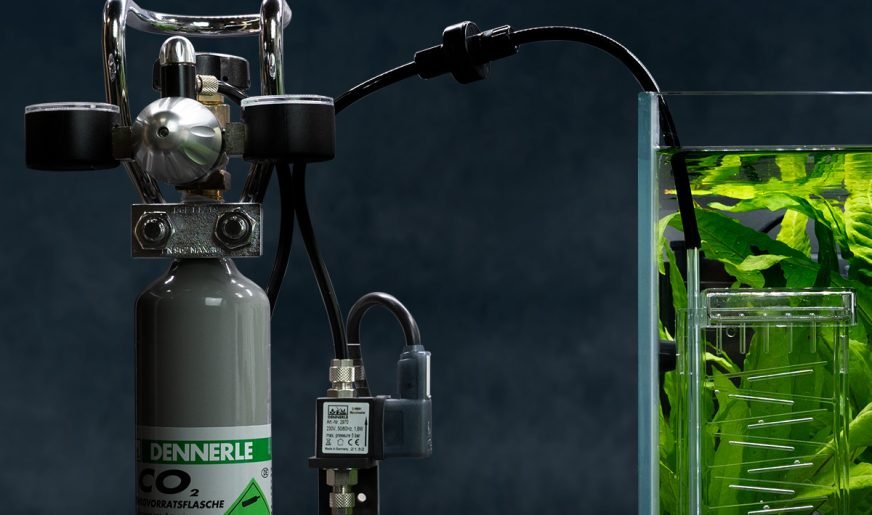
Carbon dioxide injection is one of the most impactful upgrades you can make to a planted aquarium. Plants use CO2 as their primary carbon source for photosynthesis, and in a well-lit tank with healthy substrate, CO2 is almost always the limiting factor holding back plant growth. Add it, and you will see lush, rapid growth within days. Without it, many plants simply stagnate or slowly melt away.
CO2 systems can seem intimidating at first, with regulators, diffusers, bubble counters, and drop checkers all to figure out. But the underlying concept is simple: you are dissolving a small amount of carbon dioxide gas into your aquarium water to feed your plants. This guide will walk you through every component and help you set up a system that works reliably for years.
Why Plants Need CO2
In a natural aquatic environment, plants access carbon dioxide dissolved in the water from decaying organic matter, fish respiration, and atmospheric exchange. In a closed aquarium, these sources are rarely sufficient to support fast-growing or demanding plants under strong lighting. Without supplemental CO2, even the best fertilizers and substrate cannot compensate for the carbon deficit, and plants will grow slowly, lose color, or fail entirely.
The relationship between CO2, light, and nutrients is called the limiting factor principle. Raise the light without raising CO2 and nutrients, and you get algae growth rather than plant growth, because algae can exploit light even at low CO2 levels. A balanced, injected CO2 system allows your plants to fully utilize your lighting and fertilizers, outcompeting algae in the process.
Types of CO2 Systems
There are three main types of CO2 systems available to aquarists: pressurized CO2, DIY yeast fermentation, and liquid carbon supplements. Each has distinct advantages and drawbacks depending on your budget, tank size, and how much precision you need.
Pressurized systems use a compressed CO2 cylinder connected to a regulator that controls the flow of gas into the tank. These are the most reliable and precise, suitable for all tank sizes, and the preferred choice for serious planted tank hobbyists. DIY yeast systems are low-cost and work reasonably well for small tanks but require frequent maintenance and provide inconsistent CO2 output. Liquid carbon products like glutaraldehyde-based supplements are easy to dose but provide far less CO2 than gas injection and are not suitable for demanding plants.
Pressurized CO2: Components Explained
A pressurized CO2 system consists of several key components working together. The CO2 cylinder holds the compressed gas, typically in sizes ranging from 500g paintball cylinders to 5kg or larger cylinders for big tanks. Larger cylinders last longer between refills and are more cost-effective per gram of CO2.
The regulator is the most important and most expensive component. It reduces the very high pressure inside the cylinder (around 50 bar) down to a safe working pressure, and includes a solenoid valve that allows you to automate CO2 injection on a timer. A good regulator also includes a bubble counter (to count bubbles per second for consistent dosing) and connects to a needle valve for fine-tuning flow. Buy a quality regulator from the start as cheap regulators are prone to the dangerous end-of-tank dump, where the regulator floods the tank with CO2 as the cylinder empties, killing all your fish.
Diffusers and Reactors
Once CO2 leaves the regulator, it needs to be dissolved into the water as efficiently as possible. Inline diffusers connect directly to your canister filter tubing, dissolving CO2 before the water returns to the tank. This is one of the most efficient methods and keeps equipment out of the tank. In-tank diffusers are ceramic discs that break CO2 into tiny microbubbles, increasing surface area for dissolution. They are inexpensive and effective but require regular cleaning to prevent clogging.
CO2 reactors are chambers where water and CO2 are mixed together with very high efficiency, often achieving near 100% dissolution. They are especially useful for larger tanks or high CO2 demand situations. The trade-off is that reactors are bulkier and more complex to set up than simple diffusers. For most hobbyists, a quality ceramic in-tank diffuser or an inline diffuser is perfectly sufficient.
Measuring CO2 Levels
The target CO2 concentration for planted tanks is between 20 and 30 parts per million (ppm). Below 15 ppm, most plants will not grow at their potential. Above 35 ppm, fish and invertebrates begin to show signs of CO2 toxicity, including gasping at the surface. The balance is achievable with proper equipment and monitoring.
A drop checker is the most practical way to monitor CO2 levels. It is a small glass vessel hung inside the tank that contains a pH-sensitive indicator solution. When CO2 is at ideal levels, the solution turns green. Yellow indicates too much CO2, while blue indicates too little. Drop checkers respond slowly (taking 1-2 hours to equilibrate), so they measure ambient CO2 levels rather than instantaneous levels, which is actually useful for confirming your daily average.
The CO2 and pH Relationship
CO2 dissolves in water to form carbonic acid, which lowers pH. This is a normal and expected effect of CO2 injection and is not harmful to fish when it happens gradually on a predictable cycle. What matters is the rate of change, not the absolute value. Fish that live in a tank where pH swings from 7.5 in the morning to 6.8 in the afternoon due to CO2 are perfectly fine because the change is gradual and they have adapted to it.
This pH-CO2 relationship can also be used to calculate CO2 levels using a pH/KH chart, if you know your water hardness (KH). Measure your KH and your pH, look up the value on the chart, and you have an approximate CO2 reading. This method has some limitations but works well as a cross-check alongside a drop checker.
CO2 Timing and the Solenoid Valve
CO2 should not run 24 hours a day. During the dark period when lights are off, plants are not photosynthesizing and do not consume CO2. Running CO2 at night simply wastes gas and can push CO2 to dangerous levels by morning. The standard practice is to connect your regulator solenoid to a timer and have CO2 turn on 1 hour before lights come on and turn off 1 hour before lights go off.
This pre-lighting ramp-up ensures CO2 is at optimal levels when plants begin photosynthesizing at full intensity. The 1-hour early shutoff allows CO2 to dissipate naturally before the lights go off, saving gas without impacting plant growth. Fish will benefit from higher dissolved oxygen levels during the off period as well.
DIY Yeast CO2 for Small Tanks
For tanks under 30 liters or for hobbyists who want to try CO2 before committing to a pressurized system, DIY yeast fermentation is a viable starting point. The basic setup involves mixing sugar, water, yeast, and baking soda in a sealed bottle. The yeast ferments the sugar and produces CO2 as a byproduct, which is directed into the tank via airline tubing.
The main limitations of yeast CO2 are inconsistency and maintenance. CO2 output is highest right after mixing and tapers off over 2 to 4 weeks as the sugar is exhausted. You cannot precisely control the flow rate, you cannot automate it with a solenoid, and you need to regularly prepare fresh mixtures. It works, but it is a compromise. Once you experience the reliability of a pressurized system, most hobbyists do not go back.
CO2 and Fish Safety
High CO2 levels are genuinely dangerous to fish. CO2 displaces oxygen in the blood, causing a condition called hypercapnia. Fish experiencing CO2 poisoning will gasp at the surface, appear lethargic, and may die if the problem is not corrected quickly. This is why CO2 concentration must be monitored carefully, especially during the setup phase.
Always start CO2 injection at a low bubble rate and increase gradually over several days while watching fish behavior. Run an airstone or powerhead during nighttime hours to boost surface agitation and oxygenation when CO2 is off. If fish are gasping in the morning before the CO2 timer comes on, your nighttime oxygen levels may be low, increase surface movement rather than reducing CO2 dose.
Algae Control and CO2
One of the most significant benefits of a properly dialed-in CO2 system is dramatic algae reduction. When plants receive adequate CO2 and grow vigorously, they consume the nutrients that algae depend on. Healthy, fast-growing plants also release allelopathic compounds that inhibit algae growth. Many planted tank hobbyists report that CO2 injection essentially solved their chronic algae problems within a few weeks.
The key is consistency. Fluctuating CO2 levels are actually worse for algae control than no CO2 at all, because the unstable environment stresses plants while giving algae an opportunity to take hold. Once your system is set up and stable, maintain it diligently. Do not skip CO2 days or let the cylinder run empty unexpectedly. A reliable, consistent CO2 level is the foundation of a healthy planted tank.
Cylinder Refills and Maintenance
CO2 cylinders need to be refilled when they run low. Most welding supply shops and home brew stores offer CO2 cylinder refills at reasonable prices. Never run a cylinder completely dry, as air can enter the regulator and cause issues. When the cylinder pressure drops to a low level (usually indicated by a second gauge on dual-stage regulators), schedule a refill promptly.
Diffusers require regular cleaning to prevent calcium deposits and biofilm from clogging the ceramic membrane. Soak them in a bleach solution, rinse thoroughly, and allow to dry fully before reinstalling. Check all tubing connections periodically for leaks using soapy water. A well-maintained CO2 system will run reliably for years with minimal intervention.