They look almost identical, which is the whole problem
Neon tetras and cardinal tetras are two of the most popular fish in the freshwater hobby, and at a glance they appear to be the same fish. Both are small, schooling fish from South American rivers with a horizontal blue stripe running from head to tail and a red section on the lower body. In a store tank with mixed lighting, most people cannot tell them apart. But there are clear differences once you know what to look for, and those differences affect which fish is right for your tank.
The red stripe: the key visual difference
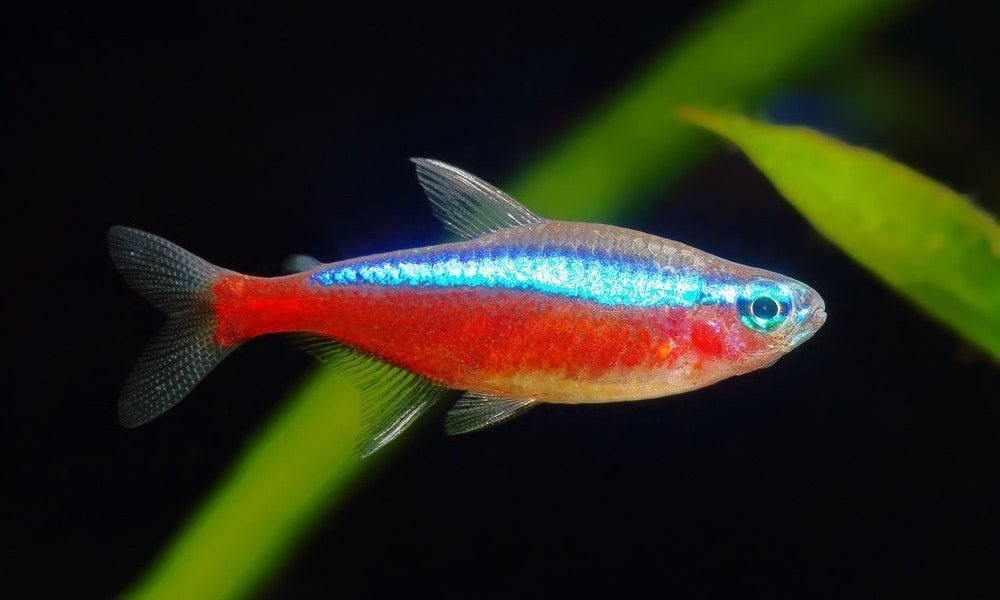
The fastest way to tell them apart is the extent of the red coloration. On a neon tetra, the red stripe starts at approximately the middle of the body and runs to the tail, covering roughly the back half. On a cardinal tetra, the red stripe runs the full length of the body, from the tail all the way to the head below the eye. Cardinals are visually more striking for this reason. A school of cardinal tetras in a dark planted tank has significantly more visual impact than the same number of neons.
Size
Cardinals are slightly larger. Neon tetras typically reach 1.2–1.5 inches as adults. Cardinal tetras grow to about 2 inches. The difference is small but visible in an established tank. Both are considered small schooling fish suitable for community tanks with peaceful species.
Water requirements
This is the most practically important difference. Neon tetras are highly adaptable and tolerate a wide pH range of 5.5–7.5 with temperatures from 68°F–79°F. Most captive-raised neons handle average tap water without issue. Cardinal tetras are significantly more demanding. They come from the blackwater rivers of the Amazon and Orinoco basins and strongly prefer soft, acidic water with pH 4.6–6.2 and temperatures of 73°F–81°F. In hard, alkaline tap water, cardinals often struggle, lose color, and have shorter lifespans.
Hardiness and lifespan
Neon tetras are hardier fish that tolerate a wider range of conditions. They are also more susceptible to neon tetra disease, a parasitic infection caused by Pleistophora hyphessobryconis, which has no cure and causes progressive color loss, cysts, and death. Cardinal tetras appear more resistant to this disease. In optimal soft, acidic water conditions, cardinals can live 4–5 years, similar to neons under good conditions.
Availability and price
Neon tetras are almost entirely captive-bred, widely available, and very affordable, typically under a dollar per fish. Most cardinal tetras sold in stores are wild-caught from the Rio Negro in Brazil, which makes them slightly more expensive and sometimes more sensitive during the adjustment period in a new tank. Captive-bred cardinals exist but are less common in the retail trade.