Why water chemistry matters more than most beginners expect
Fish evolved in very specific water conditions. The species you keep come from rivers, lakes, and oceans with distinct pH, hardness, and temperature ranges that their biology is built around. When those parameters fall outside acceptable limits, fish experience stress at the cellular level, which suppresses their immune system and makes them vulnerable to every disease in the tank. Matching your water to your fish is not optional. It is the foundation everything else rests on.
pH: the acid-alkaline scale
pH measures how acidic or alkaline water is on a scale of 0 to 14, with 7.0 being neutral. Most freshwater fish come from water with a pH between 6.5 and 7.5, though there are significant exceptions. African cichlids from the Rift Lakes prefer 7.8–8.5. Discus and cardinal tetras thrive at 5.5–6.5. Saltwater tanks typically run at 8.1–8.3. The specific pH matters less than stability. A fish kept consistently at 7.0 is healthier than one that swings between 6.5 and 7.8 every week.
General hardness (GH)
General hardness measures the concentration of calcium and magnesium ions in the water. It is expressed in degrees of hardness (dGH) or parts per million (ppm). Soft water has low GH, hard water has high GH. Species like discus, angelfish, and most tetras prefer soft water (1–8 dGH). African cichlids and livebearers like mollies and platies prefer hard water (12–20 dGH). GH also affects how fish absorb minerals, which matters for long-term health, egg development, and bone structure.
Carbonate hardness (KH) and pH stability
KH, or carbonate hardness, measures the buffering capacity of the water, its ability to resist pH swings. This is one of the most underappreciated parameters in the hobby. Low KH water is unstable and pH can crash dramatically overnight, especially in planted tanks where CO2 levels change with the light cycle. A KH of 4–8 dKH provides enough buffering for most setups. If your pH swings more than 0.5 points between morning and evening, KH is likely too low.
Temperature
Temperature affects every metabolic process in a fish, from digestion to immune response to breeding behavior. Most tropical freshwater fish do best between 74°F and 80°F (23°C–27°C). Goldfish and white cloud minnows are cold-water species that prefer 60°F–72°F. Discus need warm water at 82°F–86°F. Temperature also affects oxygen levels: warmer water holds less dissolved oxygen, which is why heavily stocked warm tanks need more surface agitation. Avoid sudden temperature changes, which stress fish even when the final temperature would be acceptable.
Ammonia, nitrite, and nitrate
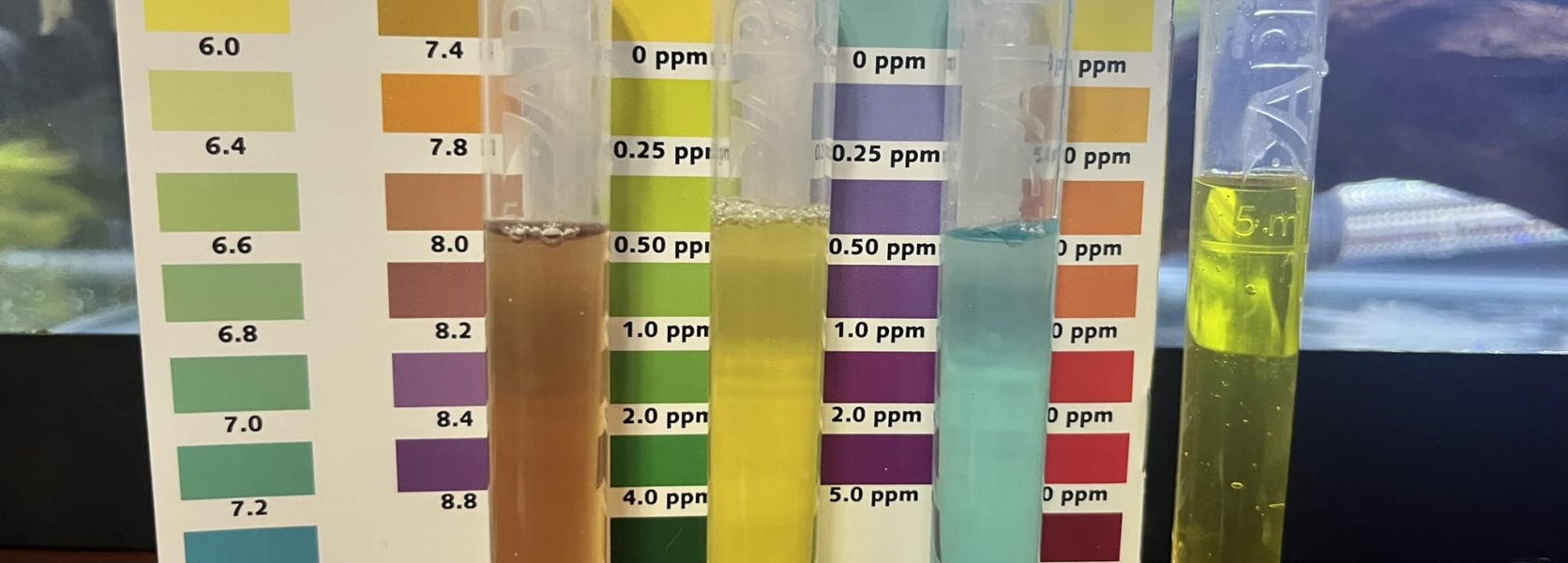
These three parameters are the direct result of the nitrogen cycle. Ammonia and nitrite should always read zero in an established tank. Any detectable ammonia is a crisis requiring immediate action. Nitrate is less acutely toxic but accumulates over time and contributes to chronic stress, disease susceptibility, and algae growth. Keep nitrate below 20 ppm for most fish, below 5 ppm for sensitive species like discus or reef tanks.
How to test and adjust
Use a liquid test kit rather than strips for accuracy. Test your tank at least weekly, and any time a fish appears unwell. To raise pH, add crushed coral or baking soda. To lower it, use driftwood, almond leaves, or peat. To soften water, use RO/DI water mixed with tap. To harden water, add mineral salts or crushed coral. Make all changes gradually, targeting no more than 0.2 pH points or 2 dGH per day to avoid shocking fish.