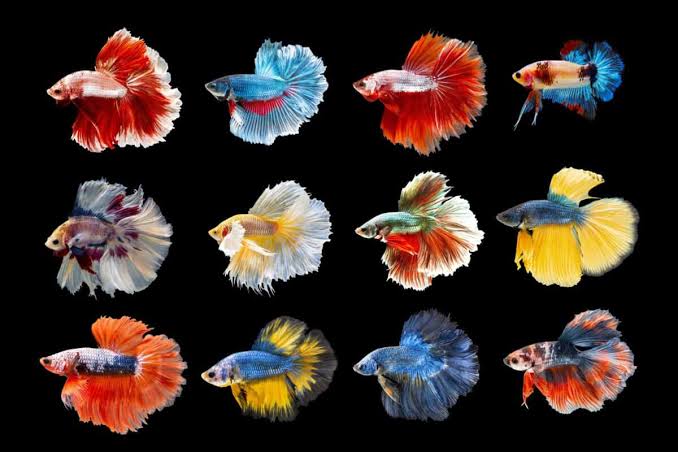
No fish in the aquarium hobby offers more visual variety than the betta fish (Betta splendens). Through decades of selective breeding, hobbyists and breeders have developed dozens of tail types and hundreds of color combinations, turning a single species into a living art form. Walk into any fish store and you will find bettas in every shade of the rainbow, with fins ranging from tidy and compact to absurdly flowing and elaborate.
Understanding the differences between tail types and color patterns helps you choose the right betta, appreciate what you are looking at, and communicate clearly with breeders. This guide covers all the major betta tail types and color categories, with explanations of what makes each unique.
Understanding Betta Genetics (Briefly)
Betta color and tail type are both controlled by genetics, but they are inherited independently. A halfmoon betta can be any color, and a delta tail can be found in every color pattern. This means the number of possible combinations is enormous: multiply roughly 10 to 12 tail types by dozens of recognized color patterns and you have hundreds of distinct varieties.
Most betta varieties available today are the result of selective breeding from captive stock. Wild bettas (Betta splendens from Thailand and neighboring countries) are relatively drab by comparison: brownish-green with short fins and subtle red or blue iridescence. The extraordinary diversity seen in pet store bettas represents generations of careful selection for specific traits by breeders around the world, particularly in Thailand, which remains the center of competitive betta breeding globally.
Veil Tail
The veil tail is the most common betta tail type seen in mainstream pet stores. The tail fin flows downward in a long, graceful drape, and the overall finnage is soft and asymmetrical. Veil tails are the least expensive and most widely bred betta variety, making them the default choice for casual hobbyists and newcomers to the hobby.
While veil tails are beautiful in their own way, they are not favored by serious breeders and are generally considered the entry-level variety. The fins are more prone to shredding in rough water current, and the gene for veil tail is dominant, meaning veil tails are easily produced but less desirable for breeding specific non-veil types. For anyone getting their first betta, a healthy veil tail is a perfectly excellent choice.
Halfmoon
The halfmoon betta is considered by many to be the gold standard of tail types. The tail forms a perfect 180-degree spread when flared, creating a semicircle that looks like a half moon. The edges of all fins are clean and straight, and the overall impression is symmetrical and elegant. Achieving a true halfmoon with a full 180-degree spread requires careful selective breeding and is a mark of quality in a betta.
Halfmoons are widely available at specialty fish stores and from dedicated breeders. They tend to be more expensive than veil tails. One consideration for keepers: the large finnage of a halfmoon can be cumbersome for the fish, making it prone to fin biting (a stress behavior where the fish bites its own fins) and more susceptible to fin rot in poor water conditions. Excellent water quality and minimal current are important for keeping halfmoon fins in top condition.
Double Tail
The double tail is one of the most distinctive betta variants: the caudal fin is split into two lobes rather than one, giving the fish an almost symmetrical appearance from behind. The body of double tail bettas is often shorter and wider than other varieties because the double-tail gene also affects body proportions. The dorsal fin is typically broader and more elaborate, matching the width of the double caudal lobes.
Double tails are beautiful but can be prone to swim bladder issues because their compact body shape affects internal organ arrangement. Feeding a varied diet and avoiding overfeeding reduces this risk. Double tail genetics are recessive, meaning that breeding two double tails guarantees double tail offspring, but crossing a double tail with a single tail produces single-tail fish that carry the gene without expressing it.
Crowntail
The crowntail is instantly recognizable by its dramatic, spiky fins. The fin rays extend beyond the fin membrane, creating points or spikes that radiate from the fin edges, resembling a crown. The amount of webbing between the rays varies: some crowntails have very reduced webbing showing long, clean spikes, while others have more webbing and shorter spikes. The most extreme form is called the crossed crowntail, where rays cross over each other.
Crowntails were developed in Indonesia in the 1990s and became enormously popular, particularly in the United States. They are widely available and come in all color patterns. Because the fin rays extend past the membrane, crowntail fins require equally clean water to stay healthy. Torn or fraying rays are a sign of either fin rot or fin biting, both of which are more visually obvious on a crowntail than on a veil tail or halfmoon.
Plakat (Short-Fin)
The plakat (pronounced pla-KAH) is the short-finned form of the fancy betta, and it most closely resembles the wild betta in body shape and fin length. The word "plakat" comes from the Thai word for fighting fish, reflecting the fact that these shorter-finned fish were the original fighting variety before elaborate fins were selectively bred.
Plakats are increasingly popular among serious hobbyists for practical reasons: they are faster swimmers, stronger, and longer-lived than heavily finned varieties because they are not burdened by dragging long fins. They are less susceptible to fin rot and fin biting. A male plakat in breeding condition displays vivid colors and short, crisp fins, and looks more like a natural fish than its long-finned counterparts. The plakat is available in all color patterns including halfmoon plakats, which spread their fins to 180 degrees but in a much shorter format.
Rose Tail and Feather Tail
The rose tail is an extreme version of the halfmoon, where the fin rays branch so extensively that the tail edges fold and overlap, creating a ruffled, rose-petal appearance. While visually dramatic, rose tails represent a case of over-breeding: the excessive branching makes the fins fragile and difficult to maintain in pristine condition. Rose tail bettas are considered a show variety rather than a practical pet choice for most keepers.
The feather tail is even more extreme, with even more extensive branching and ruffling. Both varieties can be breathtaking in photos and show competitions but are susceptible to fin damage and require immaculate water quality. For aquarists drawn to these varieties, the commitment required to keep them in top condition is significantly higher than for a halfmoon or crowntail.
Solid Colors
Solid color bettas have a single, uniform color across the body and fins. Common solid colors include red, blue, white, black, yellow, orange, and purple. A true solid-color betta with no iridescence or color variation is actually rare, because most bettas have at least some iridescent layering. Steel blue and royal blue are two of the most commonly seen solid-type colors, with the steel blue having a cooler, grayer tone and the royal blue having a vivid, saturated blue.
Red bettas are particularly striking in person, with deep crimson body and fins. Black melano bettas are intensely dark, almost matte black, but females of this variety are usually infertile due to the genetics involved in producing true melano coloration. Yellow bettas (sometimes called non-red bettas) are soft pastel yellow to rich gold and are less common than reds or blues.
Multicolor and Bicolor
A bicolor betta has a body color distinctly different from the fin color. The most dramatic bicolor combinations are ones where the body is a solid dark color and the fins are a contrasting light color, or vice versa. A common bicolor is a steel blue body with white fins, or a black body with red fins. The contrast can be striking, and bicolors are popular in competitions for their visual impact.
Multicolor bettas carry three or more distinct colors without fitting into the defined pattern categories below. These are often described informally by their dominant colors rather than any formal classification. Multicolor bettas are common in pet stores and represent a huge range of possibilities, from pastel multicolors to intense jewel-toned combinations.
Marble and Koi Patterns
The marble betta pattern is one of the most fascinating in the hobby because it is genetically unstable: marble bettas change color throughout their lives. A fish that is mostly white with blue patches may shift to mostly blue with white patches over several months, or develop red areas that were not present when the fish was young. This is caused by a jumping gene (transposon) called the marble gene that affects pigment cell migration.
The koi betta is a variety of marble developed to resemble koi pond fish, with patches of orange, white, and black on the body and fins. Koi bettas often have a metallic sheen from the dragon gene (see below) that enhances the koi illusion. They are among the most sought-after and expensive betta varieties, particularly when the koi pattern is bold and well-defined. Like all marble bettas, their pattern will shift over time, making each fish a living, changing work of art.
Dragon Scale and Metallic
The dragon scale betta has thick, opaque scales covering much of the body, creating a metallic, armor-like appearance. The scales often reflect light in a way that makes the fish appear to glow, particularly in blue and copper dragon varieties. Dragon scale bettas are available in every base color, and the dragon gene can be combined with any tail type and most color patterns.
One concern with dragon scale bettas is a condition called dragon scale eye overcrowding, where scale tissue grows over the eye and eventually impairs vision. This is a known genetic issue in heavily scaled bettas and is more common in fish bred for extreme scale coverage. When selecting a dragon scale betta, check that the eyes are clear and free of scale overgrowth. Metallic bettas without the full dragon scale pattern have a shimmering, iridescent sheen that catches light beautifully without the associated health concerns.
Choosing Your Betta
With so many options, choosing a betta comes down to personal preference and practical considerations. Plakats and crowntails are the most durable and easiest to maintain in excellent condition. Halfmoons and double tails are the most elegant but require pristine water. Koi and marble bettas offer the excitement of watching colors change over time.
Regardless of variety, always select a betta that is active, responsive, and displaying good color when you approach the tank or cup. A healthy betta will flare or at least react to its reflection. Fins should be intact with no obvious tears, clamping, or spots. Choose health over aesthetics: a stunning betta with signs of illness will likely prove more heartbreaking than rewarding.