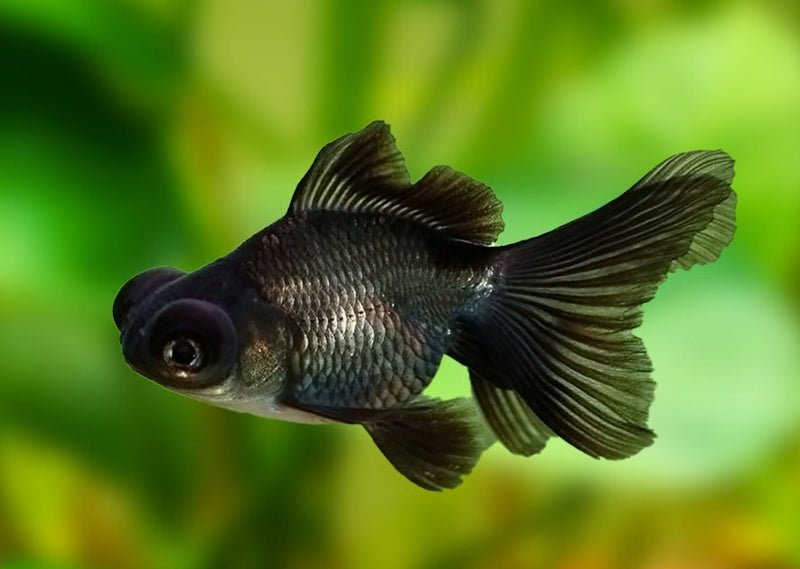
The black moor goldfish is one of the most distinctive and recognizable varieties of fancy goldfish. With its velvety black coloration and the characteristic telescope eyes that protrude from the sides of its head, it stands out dramatically in any aquarium. Black moors have a loyal following among goldfish enthusiasts precisely because of their unusual appearance and their surprisingly personable behavior.
Like all fancy goldfish, black moors have specific care needs that differ significantly from tropical fish. Understanding those needs upfront will set you up for success with a fish that can live for 10 to 15 years under the right conditions.
Species Overview
The black moor is a variety of Carassius auratus, the common goldfish, selectively bred for its protruding eyes and black coloration. It is a fancy goldfish, distinguished from common and comet goldfish by its rounder, egg-shaped body and double tail fin. Black moors grow to between 6 and 8 inches in length when kept in appropriate conditions, though they can reach up to 10 inches in large ponds.
Their telescope eyes are not just an aesthetic feature; they are also a significant care consideration. The protruding eyes are fragile and prone to injury from sharp decorations and tank edges. Poor vision makes black moors slower to find food and more vulnerable to fin-nipping tank mates. These factors must be taken into account when setting up their environment.
Ideal Tank Setup
A single black moor needs a minimum of 20 gallons, with an additional 10 gallons for each additional fish. Fancy goldfish are messy fish that produce a large bioload, so larger tanks are always preferable. Overcrowding leads to rapid water quality decline and chronic stress-related illness. A single pair of black moors is comfortable in a 40-gallon tank.
The tank should be filtered with a canister or hang-on-back filter rated for at least twice the tank volume to handle the waste goldfish produce. Goldfish do not require a heater as they are cold-water fish, preferring temperatures between 65°F and 72°F. Temperatures consistently above 75°F can stress them and reduce dissolved oxygen levels. Avoid placing the tank near windows where temperature fluctuations are common.
Substrate and Decorations
Choose smooth substrate and decorations to protect the telescope eyes. Rough gravel, sharp rocks, and plastic plants with jagged edges can puncture or abrade the delicate eye tissue. Smooth river pebbles, large rounded gravel, sand, or bare-bottom tanks are all safe options. If using artificial plants, choose silk varieties rather than stiff plastic ones.
Black moors enjoy exploring the bottom of the tank and are natural foragers. They will move gravel and sift through substrate looking for food. Large smooth stones or a bare bottom are easier to keep clean and reduce the risk of eye injury during foraging. Driftwood with smooth surfaces is safe and provides visual interest without sharp edges.
Water Parameters
Black moors thrive in water with a pH between 7.0 and 7.4, hardness of 5 to 19 dGH, and ammonia and nitrite at zero. Because goldfish are heavy waste producers, nitrate tends to accumulate quickly. Keep nitrates below 20 ppm through regular weekly water changes of 25 to 30 percent. A test kit should be used weekly to monitor parameters rather than assuming conditions are stable.
Goldfish are highly sensitive to ammonia spikes. A properly cycled tank is essential before adding any goldfish. Black moors are slightly less hardy than common goldfish due to their fancy body shape, which affects their swim bladder function. Maintaining stable, clean water reduces the incidence of swim bladder problems significantly.
Feeding
Feed black moors once or twice daily, offering only as much as they can consume in two to three minutes. Their impaired vision means they are slower eaters than other fish, so give them enough time to find and eat the food before removing excess. Sinking pellets are preferable to floating flakes for fancy goldfish because they reduce gulping of air at the surface, which can contribute to swim bladder issues.
A varied diet keeps black moors healthy. High-quality goldfish pellets should form the base of their diet, supplemented with blanched peas (peeled) to support digestive health, frozen or live daphnia and brine shrimp as treats, and blanched leafy greens like spinach or zucchini. Avoid feeding exclusively high-protein foods, as goldfish are omnivores that need plant matter in their diet.
Compatible Tank Mates
Black moors should be kept with other fancy goldfish varieties of similar size and similar handicaps. Mixing them with fast-moving common or comet goldfish is a mistake: the faster fish will outcompete the moors for food and may nip at their fins and eyes. Good tank mate options include other telescope-eyed varieties, orandas, ryukins, and fantails.
Avoid tropical fish, as the temperature preferences do not align. Warm-water tropical fish require 76°F or higher, while black moors thrive at cooler temperatures. Mixing them creates a chronic temperature compromise that is unhealthy for one group or both. White cloud mountain minnows are a rare cold-water exception that can work in a goldfish tank if the moors are not large enough to swallow them.
Common Health Problems
The most frequent health issue in black moors is swim bladder disorder, which causes fish to float uncontrollably at the surface, sink to the bottom, or swim at an angle. This is often related to constipation, overfeeding, or a diet too high in dry food that expands after ingestion. Fasting for 24 to 48 hours and then feeding peeled, blanched peas usually resolves mild cases.
Eye injuries are another common concern. Watch for cloudy or film-covered telescope eyes, which may indicate infection or physical trauma. Cloudy eyes often respond to improved water quality and aquarium salt (1 teaspoon per gallon) added to the tank temporarily. Persistent cloudiness warrants treatment with an antibiotic or antifungal product depending on the likely cause.
Color Changes
One of the most surprising aspects of black moor ownership is that the fish may change color over time. Black moors are not genetically stable in their coloration, and many transition from black to orange, bronze, or a mix of colors as they age, especially when kept in warm water or bright light. This is a natural process and not a sign of illness.
If maintaining the black coloration is important to you, keep the fish at the lower end of their preferred temperature range and in a tank where they do not receive excessive direct light. Some hobbyists prefer the color changes as part of the fish's individual character. Either way, the fish's health is not affected by the transition.
Lifespan and Long-Term Care
With proper care, black moors can live 10 to 15 years, and some have been reported to reach 20 years. The keys to longevity are a large, clean tank with consistent water quality, a varied and appropriate diet, careful selection of tank mates, and prompt attention to illness. Annual tank deep-cleans, regular filter maintenance, and consistent water changes are the foundation of long-term goldfish health.
Goldfish recognize their owners and are capable of associating feeding time with your approach to the tank. This makes them among the most interactive fish available to hobbyists, despite their simple reputation. Black moors in particular tend to be bold and curious, often swimming to the front of the tank when their keeper approaches.