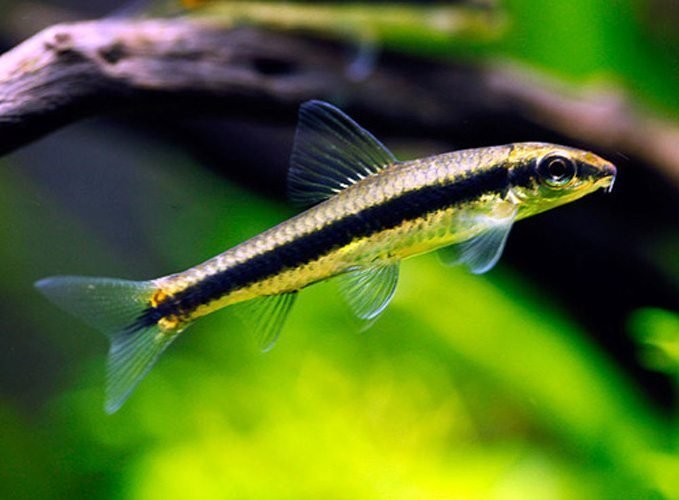
Walk into any fish store and you will almost certainly find fish labeled as either Siamese algae eaters or flying foxes, sometimes with those labels swapped or confused. These two species look remarkably similar, especially as juveniles, but they behave quite differently in the aquarium. Buying the wrong one can mean acquiring a fish that ignores algae entirely or becomes a bully to its tank mates.
Telling them apart is not difficult once you know what to look for. Understanding the behavioral and dietary differences between these two species will help you choose the right one for your specific tank and algae problems.
The True Siamese Algae Eater
The true Siamese algae eater, known scientifically as Crossocheilus oblongus, is one of the most effective algae-eating fish available to hobbyists. It is one of the very few fish that will eat black beard algae (BBA), a stubborn red algae that most other algae-eating fish ignore entirely. This single trait makes it highly sought after by planted tank enthusiasts who struggle with BBA outbreaks.
The true SAE is a slender, active fish that grows to about 6 inches in length. It has a single horizontal black stripe running from the tip of the snout to the end of the tail fin, including through the tail itself. This is the key visual identifier: the stripe continues into the caudal fin in true SAEs, while in lookalikes it stops at the base of the tail.
The Flying Fox
The flying fox, Epalzeorhynchos kalopterus, is frequently confused with the true SAE but is a different species with significantly different behavior. Flying foxes do eat some algae but are far less effective at it, particularly when it comes to BBA. If you specifically want an algae-eating workhorse, the flying fox will likely disappoint you.
Flying foxes are more territorial and aggressive than true SAEs, especially as they mature. An adult flying fox will often claim sections of the tank bottom and chase away other bottom-dwelling fish, loaches, and other flying foxes. They are generally best kept singly in community tanks, whereas true SAEs are more peaceful and can be kept in small groups.
How to Tell Them Apart Visually
The most reliable visual distinction is the black stripe. In the true SAE (Crossocheilus oblongus), the stripe has a slightly irregular, saw-toothed upper edge and runs all the way into the tail fin. In the flying fox (Epalzeorhynchos kalopterus), the stripe is cleaner with a straight upper edge, and it stops at the base of the caudal fin rather than continuing into it.
Flying foxes also have a golden or yellowish band above the black stripe that runs along the body. The dorsal fin in flying foxes typically has a black spot at the base, and the other fins often show yellow coloration. True SAEs have plainer, mostly clear fins. Looking at the fins side by side makes identification much easier, especially with juveniles where size is not yet a reliable guide.
The False Siamese Algae Eater
To complicate things further, there is a third species often mislabeled as a Siamese algae eater: the Chinese algae eater (Gyrinocheilus aymonieri). This fish is a poor algae eater as an adult and becomes increasingly aggressive with age. Adult Chinese algae eaters are notorious for attaching themselves to the sides of flat-bodied fish like discus, angelfish, and goldfish and rasping off their slime coat.
Chinese algae eaters are easy to distinguish from both SAEs and flying foxes by their body shape. They have a more rounded, stockier body, an underslung sucker-style mouth (similar to a pleco), and no distinct horizontal black stripe. They are a common sight in beginner tanks but are best avoided unless you have a very specific setup that can accommodate their territorial adult behavior.
Algae-Eating Effectiveness Compared
If your primary goal is algae control, especially against black beard algae, the true SAE is the clear winner. It actively grazes on BBA, green thread algae, and many other algae types throughout the day. Flying foxes will eat softer green algae when young but become less diligent grazers as they mature and their diet shifts toward other food sources.
Both species will eat prepared foods enthusiastically, and this can actually reduce their algae-eating motivation over time. If you want your SAEs or flying foxes to actively graze on algae, avoid overfeeding them and make sure there is sufficient algae growth to sustain their interest between feedings.
Tank Requirements for True SAEs
True Siamese algae eaters are active swimmers that need a tank of at least 30 gallons. They prefer water temperatures between 75°F and 79°F, a pH of 6.5 to 7.0, and moderate water flow. A tightly fitting lid is important because SAEs are capable jumpers, particularly when startled. They are completely peaceful toward other fish and can be kept in groups of three to six, which also encourages more confident behavior and active grazing.
They do well in planted tanks and will not harm healthy plants. They may graze on mosses like java moss, however, so keep that in mind if you have a moss wall or shrimp breeding setup where moss cover is important. A varied diet including algae wafers and occasional vegetables will keep them healthy alongside their natural grazing.
Tank Requirements for Flying Foxes
Flying foxes need similar water parameters to true SAEs but require more attention to territory. Because they become aggressive with age, keep only one flying fox per tank unless the aquarium is very large with clearly divided territories. A 40-gallon or larger tank with plenty of hiding spots, caves, and driftwood helps reduce territorial conflict.
Flying foxes can be kept with peaceful mid-water community fish like tetras, rasboras, and danios. Avoid keeping them with other bottom-dwelling species that may trigger territorial behavior. Their diet should include high-quality flake or pellet food alongside algae wafers to keep them well-nourished even when algae levels are low.
Which One Should You Buy?
If you are dealing with black beard algae or want a reliable, peaceful algae grazer, choose the true Siamese algae eater. The challenge is finding one correctly labeled. When buying, examine the tail fin carefully: if the black stripe continues into the tail, it is a true SAE. If it stops at the body, you are looking at a flying fox or another lookalike species.
If you do not have a specific algae problem and just want an interesting bottom-dwelling fish, the flying fox is a viable option, especially if kept singly. It is a more assertive personality and can add dynamic behavior to a tank, but go in knowing it will not be the algae-eating machine that the true SAE is.