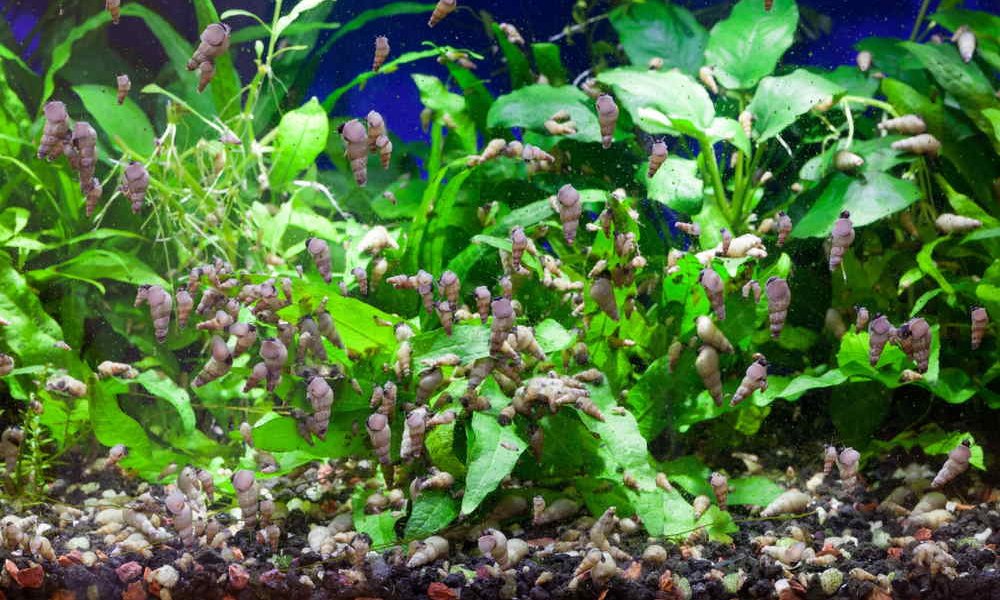
A few snails in your aquarium can be genuinely helpful. They clean up algae, eat decaying plant matter, and do not bother your fish. But snails reproduce at an extraordinary rate, and what starts as a handful of hitchhikers on new plants can turn into hundreds or even thousands of snails coating every surface in your tank within weeks.
Dealing with a snail explosion requires understanding why it happened in the first place. The answer is almost always the same: too much food available. Solving the problem means addressing the food supply while using removal methods to bring the population down to a manageable level.
Understanding Why Snails Overpopulate
Most aquarium snails are hermaphrodites and can reproduce without a mate. A single bladder snail or ramshorn snail can populate an entire tank on its own. Snail populations are controlled almost entirely by food availability. When food is abundant, they reproduce rapidly. When food is scarce, the population self-regulates.
The most common cause of snail explosions is overfeeding. Excess fish food sinking to the substrate is a feast for snails. Decomposing plant leaves, accumulated detritus, and algae all contribute too. Fixing your feeding habits is the first and most important step in long-term snail control.
Identifying Your Snail Species
Not all aquarium snails are pests. Mystery snails and nerite snails are purchased intentionally and rarely overpopulate because they lay eggs that need brackish water to hatch. The nuisance species are bladder snails (small, teardrop-shaped, often translucent), ramshorn snails (flat, spiral shell), and Malaysian trumpet snails (cone-shaped, burrow in substrate).
Knowing your species matters because some control methods work better for certain snails than others. Malaysian trumpet snails, for example, spend much of their time buried in the substrate, making them harder to physically remove but excellent targets for bait traps placed overnight.
Method 1: Manual Removal
The simplest method is physically removing snails by hand or with a net during regular maintenance. This works best as an ongoing control measure rather than a solution to a serious infestation. Spend a few minutes before each water change picking snails off the glass and decorations. Consistency matters more than the number you remove in a single session.
For larger populations, use a gravel vacuum during water changes to suck up snails and eggs from the substrate. This also removes the detritus that feeds them, addressing two problems at once. Manual removal alone rarely eliminates an infestation but slows growth when combined with other methods.
Method 2: Snail Trap Baiting
A snail trap takes advantage of the snails' strong attraction to food. Place a piece of blanched zucchini, cucumber, or a lettuce leaf on the substrate before your tank lights go out at night. By morning, dozens of snails will have clustered on the food. Remove the bait with the snails on it, dispose of them, and repeat nightly for several weeks.
Commercial snail traps shaped like small bottles or tubes work on the same principle. You place bait inside, snails enter through the opening and cannot easily exit, and you remove the trap in the morning. This method is labor-intensive but completely chemical-free and safe for all tank inhabitants.
Method 3: Introducing Snail-Eating Fish
Several popular aquarium fish actively hunt and eat snails. Assassin snails (Clea helena) are the most effective biological control. These predatory snails hunt and eat pest snails methodically without bothering fish or plants, and they reproduce slowly enough not to become a problem themselves. Adding a small group to an infested tank will gradually reduce snail numbers over weeks.
Loaches, particularly clown loaches and yoyo loaches, are enthusiastic snail predators. They will dig Malaysian trumpet snails out of the substrate and crack the shells of ramshorn and bladder snails. Pea pufferfish are another excellent option, as snails make up the majority of their natural diet. However, pufferfish require species-only tanks or very carefully selected tank mates due to their nippy behavior.
Method 4: Chemical Treatments
Chemical treatments like copper-based medications or products specifically designed to kill snails (such as API Snail-X or Aquarium Pharmaceuticals Had-A-Snail) can eliminate large infestations quickly. However, copper is highly toxic to invertebrates including shrimp, assassin snails, and some sensitive fish, so it must be used with great caution.
If you choose a chemical treatment, remove all invertebrates and snails you want to keep first. Follow the dosing instructions precisely. After treatment, perform large water changes and run activated carbon in your filter to remove residual chemicals. Be aware that a large die-off of snails releases ammonia into the water, potentially crashing your tank's nitrogen cycle. Monitor water parameters closely for several days after treatment.
Method 5: Removing Food Sources
Reducing the food available to snails is the most sustainable long-term control strategy. Feed your fish only what they consume in two to three minutes. Remove uneaten food promptly with a net or turkey baster. Trim and remove dead or dying plant leaves before they decompose on the substrate. Keep up with regular gravel vacuuming to remove accumulated detritus.
When the food supply drops, snail populations crash naturally. Eggs fail to hatch, juveniles do not survive, and adults die without reproducing. This process takes a few weeks but is completely safe for the tank ecosystem and does not require chemicals or purchasing additional animals.
Preventing Future Infestations
The most effective prevention is quarantining new plants before adding them to your display tank. Keep new plants in a separate bucket or tank for one to two weeks. Snail eggs are transparent and nearly invisible but will hatch during the quarantine period, revealing themselves before they reach your main tank.
You can also dip new plants in a dilute bleach solution (19 parts water to 1 part bleach for 2 minutes) or a potassium permanganate solution before adding them. Rinse thoroughly afterward and keep the plant in clean water for a day before planting. This kills snail eggs as well as algae spores and some parasites.
When a Full Reset Is Necessary
In extreme cases, when a tank is overwhelmed with thousands of snails and other methods have not worked, a full tank reset may be the most practical solution. Remove all fish to a temporary holding tank, drain the display, bleach the substrate and decorations, rinse everything thoroughly, and restart the nitrogen cycle. This is a last resort but guarantees a snail-free start.
Before resetting, save your filter media in a bucket of tank water to preserve the beneficial bacteria. The bacteria in your filter are your most valuable asset and the only thing worth preserving from an infested setup.