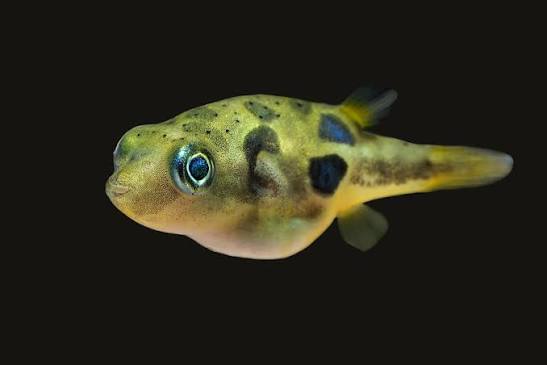
Do not let the size fool you. The pea puffer (Carinotetraodon travancoricus) measures barely an inch long, but it carries the attitude of a fish ten times its size. With its enormous expressive eyes, rotund body, and habit of hovering in place while studying its surroundings with apparent curiosity, the pea puffer is one of the most personable and entertaining fish in the freshwater hobby.
Also called the dwarf pufferfish, pygmy puffer, or Malabar pufferfish, this species is endemic to a small region of Kerala, India, where it lives in slow-moving, densely vegetated rivers and backwaters. It is the world's smallest pufferfish species, and despite its size, it shares all the intelligence, aggression, and dietary quirks of its larger puffer relatives. This guide covers everything you need to keep pea puffers successfully and enjoy everything this tiny species has to offer.
Appearance and Personality
The pea puffer's body is small, round, and covered in fine speckled patterning: a yellow-green to olive base with dark brown spots or patches across the body and pale undersides. The eyes are disproportionately large relative to the body, and they move independently, giving the fish an almost cartoonish, alert expression. Males develop a dark stripe running along the belly and often show more intense yellow coloration during breeding condition.
What sets pea puffers apart from most fish is their behavior. They are genuinely curious and interactive, and will often approach the front glass and appear to study the person watching them. They hover in place, tilting slightly as they observe their environment, and respond to feeding time with obvious excitement. Many keepers report that their pea puffers recognize them specifically and respond differently to different people, though whether this is true recognition or simply a conditioned response to being fed is debated. Either way, the effect is charming and makes pea puffers unusually engaging pets.
Tank Size and Setup
Despite their tiny size, pea puffers need more space per fish than their dimensions suggest. Each pea puffer should have at least 5 gallons of dedicated space, so a single puffer needs a 5-gallon minimum, a pair needs 10 gallons, and so on. This accounts for their territorial nature and the fact that they need enough sightlines and hiding spots to establish personal space without constant conflict.
The tank should be heavily planted. Dense planting replicates the pea puffer's natural habitat and serves two critical functions: it provides the visual barriers that reduce territorial stress, and it gives the fish something to explore and investigate throughout the day. Java fern, java moss, anubias, hornwort, and floating plants like water sprite or salvinia are all excellent choices. Driftwood and small rock caves add further hiding spots and surface area for grazing.
A dark substrate (fine dark sand or small dark gravel) contrasts beautifully with the pea puffer's coloration and mimics the murky river bottoms of their native habitat. Keep flow gentle: pea puffers come from slow-moving water and are not strong swimmers. A sponge filter or a gentle hang-on-back filter with a baffle to reduce outflow turbulence works well.
Water Parameters
Pea puffers are adaptable to a range of conditions but do best in soft to moderately hard, slightly acidic to neutral water. Target pH between 7.0 and 7.5, temperature between 74 and 82 degrees Fahrenheit (23 to 28 degrees Celsius), and hardness between 5 and 15 dGH. These parameters loosely replicate their native Kerala rivers, which are warm, soft, and tea-colored from organic tannins.
Water quality is critically important for pea puffers. They are sensitive to ammonia and nitrite and should only ever be added to a fully cycled aquarium. Nitrates should be kept below 20 ppm, and weekly water changes of 20 to 30% are essential. Unlike some hardy fish that tolerate neglect, pea puffers will show the effects of poor water quality quickly through lethargy, color fading, and susceptibility to ich and other parasitic infections.
Diet: The Snail Obsession
Pea puffers are obligate carnivores with a particular love of snails. In the wild they eat small invertebrates, snails, crustaceans, and insect larvae. Their teeth (the four tooth plates that form the characteristic puffer beak) are designed for crushing hard-shelled prey. Snail shells provide the necessary beak-wearing action that keeps their teeth from overgrowing, which is a genuine health concern in pea puffers fed only soft foods.
The most practical staple food for pea puffers is pond snails or ramshorn snails, which can be cultivated in a separate container at minimal cost. Feed snails two to three times per week as the primary diet. Supplement with frozen bloodworms, frozen brine shrimp, and live blackworms. Most pea puffers will refuse dry pellets or flake food, at least initially. Some individuals can be trained to accept frozen foods thawed and offered on a thin skewer, but live and frozen foods should remain the dietary foundation.
Culturing your own snail colony in a separate bucket or small tank with lettuce or algae wafers as food is highly recommended. It ensures a constant, free supply of the puffer's favorite food and eliminates dependence on pet store stock. Bladder snails, which reproduce rapidly and are often considered pests in planted tanks, are ideal pea puffer food: small, soft-shelled, and endlessly produced.
Aggression and Tankmates
Pea puffers have a reputation for aggression that is only partly warranted. They are territorial toward their own species, and males will fight, fin-nip, and stress each other in cramped quarters. However, with a well-planted tank and correct stocking density, groups can coexist. The recommended approach for keeping a group is one male to two to three females, with the tank heavily planted to break sightlines between males.
Toward other species, pea puffers are notorious fin nippers. Long-finned fish like bettas, guppies, and angelfish will have their fins nipped relentlessly. The pea puffer's small size does not protect other fish from this behavior. Some keepers successfully keep pea puffers with very fast, short-finned species like danios, or with bottom-dwelling fish that avoid the puffer's territory. Otocinclus catfish are a commonly cited success story as tankmates, though individual puffer personalities vary.
The safest approach for most keepers is to maintain pea puffers in a species-only tank. A pea puffer species tank in a well-planted aquarium is self-sufficient, fascinating to observe, and eliminates the compatibility guesswork entirely. For community tank integration, proceed cautiously and have a backup plan.
Breeding Pea Puffers
Breeding pea puffers in captivity is achievable with the right setup and a properly conditioned pair. The male initiates courtship with a hovering display, showing off his intensified yellow belly coloration and following the female closely. If receptive, the female will lead the male to a planting area where eggs are deposited among fine-leaved plants like java moss or floating plant roots.
Spawning produces a small number of eggs (often 5 to 20) scattered among plants. The eggs are clear and adhesive, about 1mm in diameter. Unlike many fish, pea puffers provide no parental care after spawning, and adults may eat the eggs or fry if left together. For successful breeding, move the eggs carefully to a separate hatching container or use a breeder box within the main tank.
Eggs hatch in approximately 5 to 7 days. Fry are tiny but immediately capable of hunting. Start with infusoria or vinegar eels as first foods, transitioning to baby brine shrimp and micro worms after one to two weeks. Fry growth is slow by most fish standards, and it takes several months to reach adult size. Despite the slow timeline, successful breeding of pea puffers is a rewarding achievement.
Common Health Issues
The most common health problem in pea puffers is ich (white spot disease), which appears as small white dots on the body and fins, often accompanied by flashing (rubbing against objects) and loss of appetite. Pea puffers are particularly susceptible when stressed by poor water quality, transport, or temperature swings. Treat with elevated temperature (82 to 86 degrees Fahrenheit) combined with ich medication. Note that pea puffers are sensitive to many medications containing formalin or other harsh chemicals, so use half the recommended dose as a starting point.
Overgrowing teeth are a uniquely puffer concern. If pea puffers are not regularly given hard foods (snails in particular), their beak can overgrow and prevent them from eating. Signs include loss of appetite, difficulty grasping food, or the fish bringing food to its mouth and then dropping it. Treatment involves manually trimming the teeth under sedation, which requires a vet experienced with fish. Prevention through regular snail feeding is far preferable to treatment.
Bloat is another condition seen in pea puffers, presenting as a swollen abdomen and lethargy. It can be caused by bacterial infection, internal parasites, or constipation from improper diet. Ensure dietary variety, include occasional live or frozen daphnia (which acts as a natural laxative for fish), and maintain excellent water quality to minimize this risk.
Where to Buy Pea Puffers
Pea puffers are widely available in the aquarium trade, though they are more commonly found at specialty fish stores than at chain pet stores. Prices typically range from $5 to $15 per fish depending on the source. When selecting pea puffers, choose individuals that are active, alert, and round-bodied. A healthy pea puffer has a slightly rounded abdomen: a sunken or pinched belly is a warning sign of malnutrition or internal parasites.
Wild-caught pea puffers should be treated prophylactically for internal parasites upon arrival, as wild specimens frequently carry worm loads. Captive-bred specimens, when available, are preferable for this reason. Quarantine new pea puffers for two to four weeks before introducing them to an established tank, and observe for signs of ich, which is frequently introduced by new fish from store tanks.